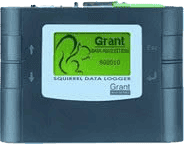
Grant Instruments SQ2010
A powerful portable data logger for everyday use
The Squirrel 2010 is a versatile, general purpose logger, with 4 to 8 analogue input channels to measure current, voltage, resistance and temperature, plus 8 digital channels. All can be logged or used as triggers to automatically start or stop logging.
It is a compact, portable logger which is also suitable for bench based and fixed installations. Easily programmed via the four integral push buttons and large graphical display and with a basic accuracy of 0.1%, the Squirrel 2010 is able to fulfil many routine data logging needs, including more demanding applications requiring up to 10 readings per second on one channel.
-
- Flexible
-
- Very easy to use
-
- Economical
-
- Handheld, ergonomic design
-
- USB connectivity with PC
-
- Ethernet or RS232 communications options available
-
- Extended battery life for unattended logging
Key Features
-
- Compact, portable data logger
-
- Powered from internal cells, external PSU or via USB connection
-
- 4 to 8 universal analogue inputs (current, voltage, resistance, temperature) plus 8 digital inputs
-
- 16 derived/calculated channels
-
- 2 alarm outputs
-
- 2 pulse counter inputs (1 at up to 64kHz, 1 at up to 100Hz)
-
- Configured via large easy-to-read graphical display
-
- 1% accuracy, 24-bit A to D conversion
-
- Up to 14 million readings
-
- Supplied with SquirrelView set-up/download and export software
-
- Up to 10 readings per second on 1 channel
Analogue inputs supported
-
- Thermistors
-
- Thermocouples
-
- Voltage
-
- Current
-
- Resistance
Key Capabilities
-
- Create complex schedules of logging rates, triggers and alarm outputs
-
- Scale and view readings in real time on the integral display or on a PC running SquirrelView or Excel
-
- Display readings in preferred engineering units e.g. Hz, Bar, Pascals, Nm etc.
-
- Select logging rates up to 10 Hz. Single channel only
-
- Derive up to 16 calculated (virtual) channels from real input channels using mathematical functions
-
- Concurrently sample channels at different sample speeds